
Medicare & GLP-1 Drugs: What Is the New GLP-1 Bridge Program?
GLP-1 medications have received a great deal of attention in recent years, particularly medications used for weight management.
For people with Medicare, however, figuring out when one of these medications may be covered hasn’t always been simple.
That changed somewhat on July 1, 2026, when the Centers for Medicare & Medicaid Services (CMS) launched a temporary program called the Medicare GLP-1 Bridge.
The program creates a new pathway for certain eligible Medicare Part D beneficiaries to access qualifying GLP-1 medications for weight management.
But it is important to understand what the program does—and what it does not do.
What Is the Medicare GLP-1 Bridge?
The Medicare GLP-1 Bridge is a temporary CMS demonstration that began July 1, 2026.
CMS currently plans to operate the program through December 31, 2027.
Unlike a normal prescription filled through your Medicare Part D plan, medications provided through the GLP-1 Bridge are processed outside of the regular Part D benefit and payment system.
How Much Does It Cost?
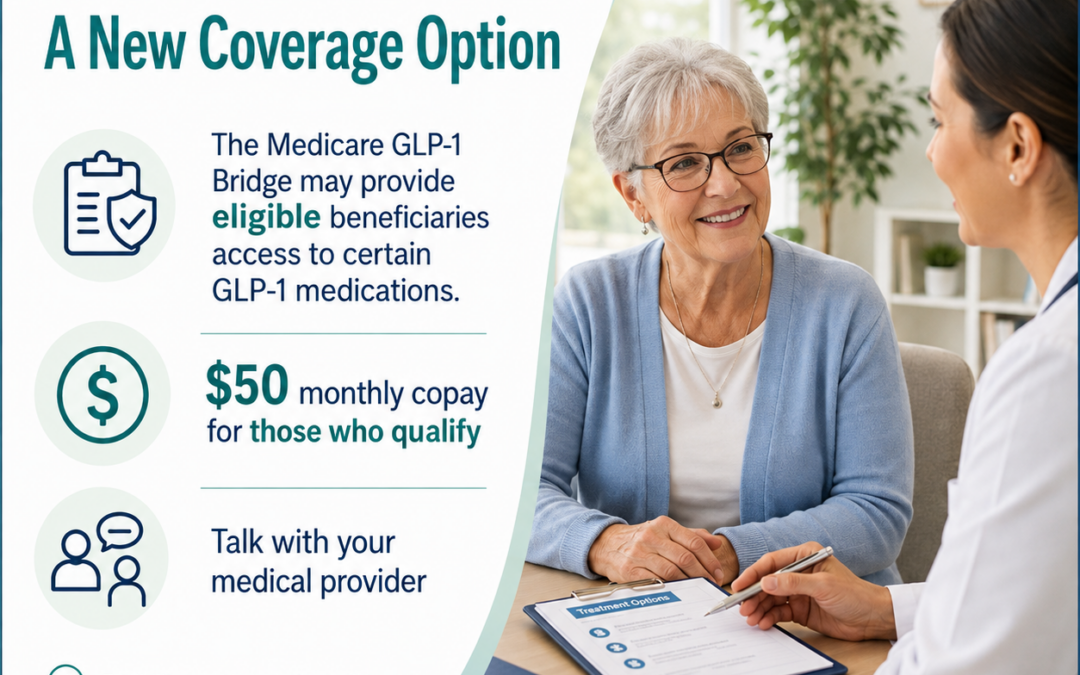
Eligible beneficiaries pay a $50 copay for a monthly supply of an eligible GLP-1 medication obtained through the program.
Because the Bridge operates outside the regular Part D benefit:
- The Part D deductible does not apply.
- The $50 copay does not count toward Part D true out-of-pocket costs.
- Part D Low-Income Subsidy cost sharing does not reduce the $50 Bridge copay.
Those distinctions can be easy to miss when hearing simply that Medicare beneficiaries may be able to obtain a GLP-1 for $50.
Which GLP-1 Medications Are Included?
CMS currently lists certain formulations of:
- Wegovy
- Zepbound
- Foundayo
as eligible medications when used for purposes covered by the Medicare GLP-1 Bridge.
The list can change during the demonstration, so beneficiaries and prescribers should check current CMS information rather than relying on an older list.
Does Everyone With Medicare Qualify?
No.
This may be the most important part of the program to understand.
The Medicare GLP-1 Bridge is available only to qualifying Medicare Part D beneficiaries who meet specific clinical criteria.
A medical provider must submit a prior authorization request and attest that the medication is being prescribed to reduce excess body weight and maintain weight reduction along with ongoing lifestyle modification involving nutrition and physical activity.
CMS currently identifies several pathways for meeting the clinical criteria.
A beneficiary may qualify if, at the time GLP-1 therapy was initiated, the individual was:
- BMI of 35 or greater, or
- BMI of 30 or greater along with certain conditions such as heart failure with preserved ejection fraction, uncontrolled hypertension, or stage 3a or greater chronic kidney disease, or
- BMI of 27 or greater along with certain conditions such as prediabetes, previous heart attack, previous stroke, or symptomatic peripheral artery disease.
Meeting one of these thresholds does not by itself guarantee access. The prescriber must submit the required prior authorization and the beneficiary must satisfy the complete CMS eligibility requirements.
What If I Take a GLP-1 for Diabetes or Another Medical Condition?
This is where the rules become particularly important.
The GLP-1 Bridge was designed for eligible beneficiaries using these medications for weight management.
CMS explains that certain uses of GLP-1 medications—such as treatment related to type 2 diabetes, moderate-to-severe obstructive sleep apnea, and certain liver disease indications—can already qualify for coverage through the regular Medicare Part D benefit.
When a medication is being prescribed for a Part D-covered indication, the beneficiary should generally obtain the medication through their Part D plan rather than through the GLP-1 Bridge.
What If I’m Already Taking a GLP-1?
Existing use doesn’t automatically determine eligibility one way or the other.
CMS evaluates whether a beneficiary has previously received a GLP-1 through Medicare Part D and whether the medication is being prescribed for an indication already covered under Part D.
CMS also says the clinical BMI criteria are based on the beneficiary’s status when GLP-1 therapy was initiated, not necessarily the person’s current BMI when the prior authorization is submitted.
That is an important distinction for someone who has already lost weight while receiving treatment.
How Does Someone Apply?
This isn’t a program where the beneficiary simply fills out an online application and receives medication.
The process begins with the individual’s medical provider.
For an eligible beneficiary to receive medication through the Medicare GLP-1 Bridge, a medical provider must prescribe an eligible medication for an appropriate use and complete the required prior authorization process.
CMS recommends that beneficiaries interested in the program talk with their doctor or other medical provider about whether a GLP-1 medication is medically appropriate and whether they may meet the Bridge eligibility requirements.
The Bottom Line
The Medicare GLP-1 Bridge represents an important change in access to certain weight-management medications for some people with Medicare.
But the headline shouldn’t be:
“Medicare now covers weight-loss drugs for $50.”
That’s too broad.
A more accurate takeaway is:
Certain Medicare Part D beneficiaries who meet specific medical requirements may now have access to qualifying GLP-1 medications for weight management through a temporary CMS program with a $50 monthly copay.
If you’re interested in GLP-1 treatment, don’t assume that you’re covered—or that you’re not.
Talk with your medical provider, review the current Medicare requirements, and determine which coverage pathway applies to your individual situation.
The Medicare GLP-1 Bridge is currently scheduled to continue through December 31, 2027.
This article is for general educational purposes and is not medical advice. Eligibility, covered medications and program requirements may change. Information is based on CMS guidance available in August 2026.
Questions about your Part D Prescription Drug Plan? Contact us at TCG Insurance Solutions