
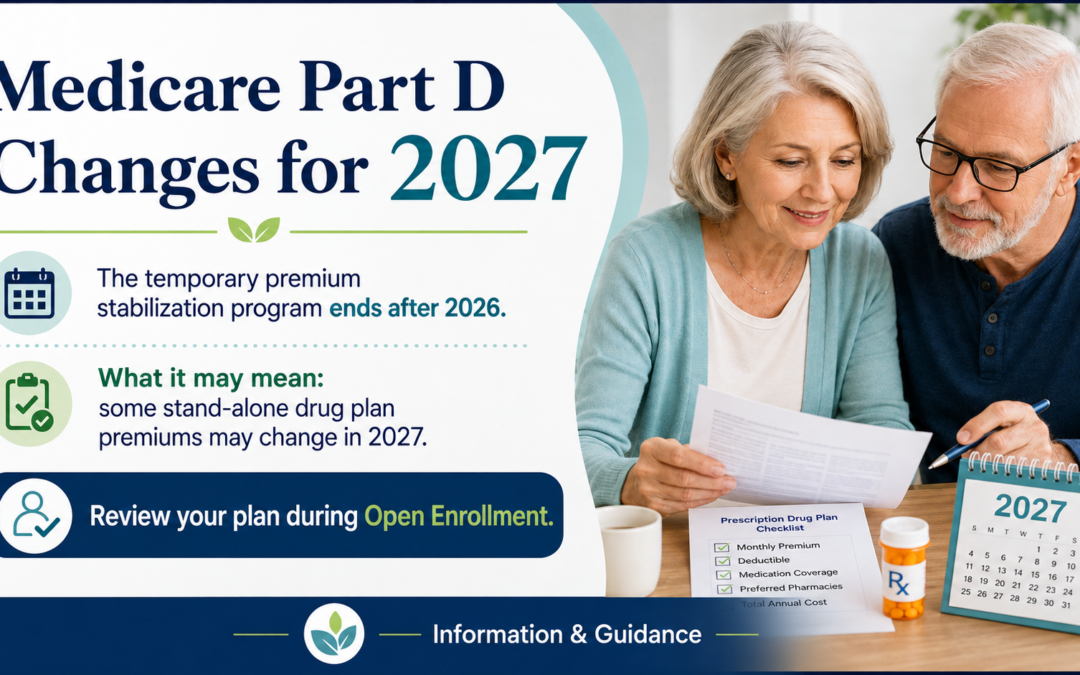
Medicare Part D Premium Stabilization Program Ends After 2026: What Could It Mean for 2027?
If you have a stand-alone Medicare Part D prescription drug plan, there is a change coming in 2027 that is worth understanding.
On July 28, 2026, the Centers for Medicare & Medicaid Services (CMS) announced that it will discontinue the Part D Premium Stabilization Demonstration at the end of 2026.
That announcement has generated discussion about whether Medicare prescription drug plan premiums could increase in 2027.
The short answer is: some plans could see larger premium changes, but it is too early to know what any particular beneficiary will pay.
Here’s what we know so far.
What Was the Part D Premium Stabilization Demonstration?
The Part D Premium Stabilization Demonstration was a temporary program introduced in 2025 as Medicare implemented significant changes to the Part D prescription drug benefit.
Its purpose was to reduce volatility in premiums for participating stand-alone Prescription Drug Plans (PDPs) while insurance companies gained experience operating under the redesigned Part D benefit.
For 2026, the demonstration provided two important forms of premium stabilization for participating plans:
- A $10 reduction in the base beneficiary premium used in calculating plan premiums.
- A limit of $50 on the year-over-year increase in a participating plan’s monthly Part D premium.
The federal government provided additional subsidies to participating plans to fund those premium reductions.
Those additional demonstration provisions will no longer apply beginning in 2027.
Why Is CMS Ending the Program?
CMS says that Part D insurers now have sufficient experience with the redesigned Part D benefit to develop their 2027 bids without the additional premium stabilization provided through the demonstration.
CMS describes the change as returning the stand-alone Part D market to more traditional market conditions.
The demonstration was always temporary, although its design allowed CMS to continue it into additional years depending upon market conditions.
Does This Mean Part D Premiums Are Going Up in 2027?
Not necessarily — and this is where it’s important not to get ahead of the actual numbers.
The end of the demonstration removes an additional layer of premium protection that participating stand-alone Part D plans received in 2025 and 2026.
KFF notes that without those additional subsidies, some stand-alone Part D enrollees could experience larger premium increases in 2027 than they have experienced in recent years.
However, individual 2027 plan premiums have not yet been released.
CMS expects to release the final 2027 Medicare Advantage and Part D plan landscape, including average premium information, in mid-to-late September 2026.
Until those numbers are available, claims about exactly how much a particular person’s premium will increase are speculation.
What About the 6% Part D Premium Limit?
This is an important distinction.
The Inflation Reduction Act includes a provision limiting the annual increase in the national Part D base beneficiary premium to no more than 6% annually from 2024 through 2029.
That provision is not ending.
CMS has announced that the national base beneficiary premium will be $41.33 for 2027, compared with $38.99 in 2026.
But the national base beneficiary premium is not necessarily the premium you pay for your individual Part D plan.
Actual premiums vary by insurance company and plan. The separate Premium Stabilization Demonstration provided additional protection to participating stand-alone PDPs. It is that temporary program that is ending.
Does This Affect Medicare Advantage Drug Coverage?
The Premium Stabilization Demonstration applied specifically to stand-alone Medicare Part D Prescription Drug Plans.
It did not apply to Medicare Advantage plans that include prescription drug coverage, commonly called MA-PD plans.
Medicare Advantage plans can still experience their own changes in premiums, drug coverage, formularies, copays, networks and other benefits for 2027, but those changes are separate from the expiration of this particular demonstration.
What Should Medicare Beneficiaries Do?
Right now? Probably nothing.
There is no reason to make a coverage decision based solely on this announcement.
The important time will come when 2027 plan information becomes available and beneficiaries receive their plan’s Annual Notice of Change (ANOC).
That’s when it makes sense to compare what you currently have with what will be available for 2027.
And don’t compare premiums alone.
When reviewing Part D coverage, consider:
- Whether your prescriptions remain on the formulary
- Changes in drug tiers
- Copays and coinsurance
- Preferred pharmacy networks
- Deductibles
- Monthly premiums
- Prior authorization or other utilization requirements
- Your estimated total annual prescription cost
A plan with a $10 lower monthly premium isn’t necessarily a better value if one of your medications costs substantially more under that plan.
The Bottom Line
The Part D Premium Stabilization Demonstration is ending after 2026, and that means one temporary mechanism used to moderate stand-alone prescription drug plan premiums will no longer be available in 2027.
That could result in larger premium changes for some plans.
But we won’t know the real impact until the 2027 plan premiums and benefits are released.
So this isn’t a reason to worry.
It’s a reason to pay attention.
When your 2027 Medicare information arrives this fall, take a few minutes to review your prescription drug coverage instead of assuming that what worked well in 2026 will automatically remain your best option in 2027. If you need help reviewing other available plans in Kansas and Missouri, contact us at TCG Insurance Solutions
Reviewed is better than simply renewed.
Information is based on CMS announcements available as of August 2026. Medicare plan premiums, benefits and formularies may change annually.